
A cold plunge chiller noise figure is useful only when you know what was measured, where the microphone was placed and what the complete system was doing. Before comparing suppliers, ask for the exact configuration, operating mode, sound metric, measurement position and background conditions. A bare “dB” number or a short video cannot establish which unit will be quieter at your site.
For distributors, the task is to avoid carrying an unsupported noise claim into a product listing. For a hotel, gym or wellness project, it is to decide whether the proposed equipment and location can meet an agreed acoustic requirement. Both decisions need a report that can be traced to the quoted product.
Scope: This is a buyer’s method for reviewing noise evidence, not a Bropool acoustic test report. The current Bropool records reviewed on 11 October 2026 do not establish a comparable decibel rating for the models pictured here. No quietest-model ranking, universal acceptable level or noise-compliance claim is made. Use the Cold Plunge Buyer Specification Guide for the wider equipment brief.

What a cold plunge chiller noise figure actually means
Start by separating sound pressure level from sound power level. A sound-pressure result describes the measurement at a stated position; distance and the surrounding environment matter. Sound power describes the sound emitted by the source. The two values are not interchangeable simply because both are expressed in decibels. Daikin’s explanation of sound pressure and sound power sets out this distinction and the effect of distance and reflections. It explains the terms; it is not evidence about Bropool products.
Next, read the full metric. LAeq,T is an A-weighted equivalent sound level over a stated period T. LAFmax is the maximum A-weighted, Fast-time-weighted level during the measurement. An average and a maximum answer different questions. NTi Audio explains LAeq and LAFmax, including frequency weighting, time weighting and energy averaging. Ask the supplier to name the metric and duration rather than sending a cropped display reading.
Illustrative comparison, not product data: suppose one quotation says “48 dB” and another reports “LAeq, 5 minutes: 51 dB, measured at a marked position while cooling.” The first number is lower, but the missing metric, position and operating state prevent a defensible ranking. Request the missing information or a matched test. Do not invent a correction between unlike reports.
Also define the product being assessed. The Bropool cold plunge range includes external-chiller, integrated and direct-cooling ice-making routes. The CT-20 product record identifies an integrated cooling enclosure and leaves performance data for configuration-specific confirmation. A test of a separate chiller alone is not automatically a test of a complete tub, pump and cabinet assembly.
Use this supplier noise report checklist
Send the same checklist to each supplier before a demonstration or sample review. These are requested report fields, not a claim that Bropool performs or includes an acoustic test with every order. If a field is missing, keep the comparison open instead of treating the absence as a pass.
| Report field | Ask the supplier to record | What remains unresolved without it |
|---|---|---|
| Product identity | Tub, cooling unit, pump, controller, electrical version, options and sample identifier. | Whether the result belongs to the configuration being quoted. |
| System boundary | The components running during measurement; normal panels, hoses and fittings in place. | Whether a chiller-only result represents the complete operating assembly. |
| Metric and period | Sound pressure or sound power, weighting, average or maximum, and measurement duration. | Whether the reported numbers describe the same quantity. |
| Microphone position | Marked reference point, distance, height and side of the equipment, with a setup photograph. | Whether position differences explain the apparent advantage. |
| Test environment | Indoor or outdoor setting, nearby surfaces, support, other equipment and relevant ambient conditions. | Whether the test surroundings resemble each other or the intended installation. |
| Background record | The background with the tested system off, where safe; the method used to assess its effect. | How much of the measured result can be attributed to the tested system. |
| Operating condition | Water volume and temperature, setpoint, cover state, mode, and which components are active. | Whether the recording captures active cooling, holding or another state. |
| Method and traceability | Instrument and microphone, calibration record, checks, operator, date, method and stated uncertainty. | Whether the result is traceable and suitable for the agreed decision. |
On a small screen, scroll within the table to read the final column.
A phone clip can help show when a hum, rattle or change occurs. Treat it as supporting context unless the measurement chain and method are documented. Do not use playback through different phones or speakers as a calibrated comparison. For a contractual threshold or a noise-sensitive location, agree the measurement method with a qualified acoustic professional and ask the supplier whether it can provide the required evidence.
Compare operating modes, not a quiet moment
A useful demonstration follows the intended operating sequence. Ask what is running in each clip or logged period and keep the configuration unchanged. A quiet holding interval should not stand in for active cooling. Where the controller normally cycles equipment, request a record that identifies those transitions instead of a selected few seconds.
| State to request | What the record should show | Comparison to avoid |
|---|---|---|
| Active cooling | Starting water condition, setpoint, active equipment and the measurement interval. | One unit actively cooling versus another with its compressor inactive. |
| Temperature holding | The observed control cycle, circulation state and duration covered by the record. | A short quiet interval presented as continuous all-day operation. |
| Additional normal modes | Any relevant ice-making or defrost operation, only as specified for that model. | Assuming every cooling route has the same sequence or sound profile. |
For the differences between system layouts, use the external, integrated and ice-making comparison. That layout decision does not settle noise performance. Neither an integrated cabinet nor an external chiller is automatically the quieter choice.
Check the proposed installation without blocking airflow
Mark both the equipment location and the places where sound matters: the user’s position, a reception desk, an adjoining room or another project-specific receiver. Record nearby walls and partitions, the proposed support and the ventilation and service zones. Keep a supplier’s product test separate from the acoustic assessment of the finished site.
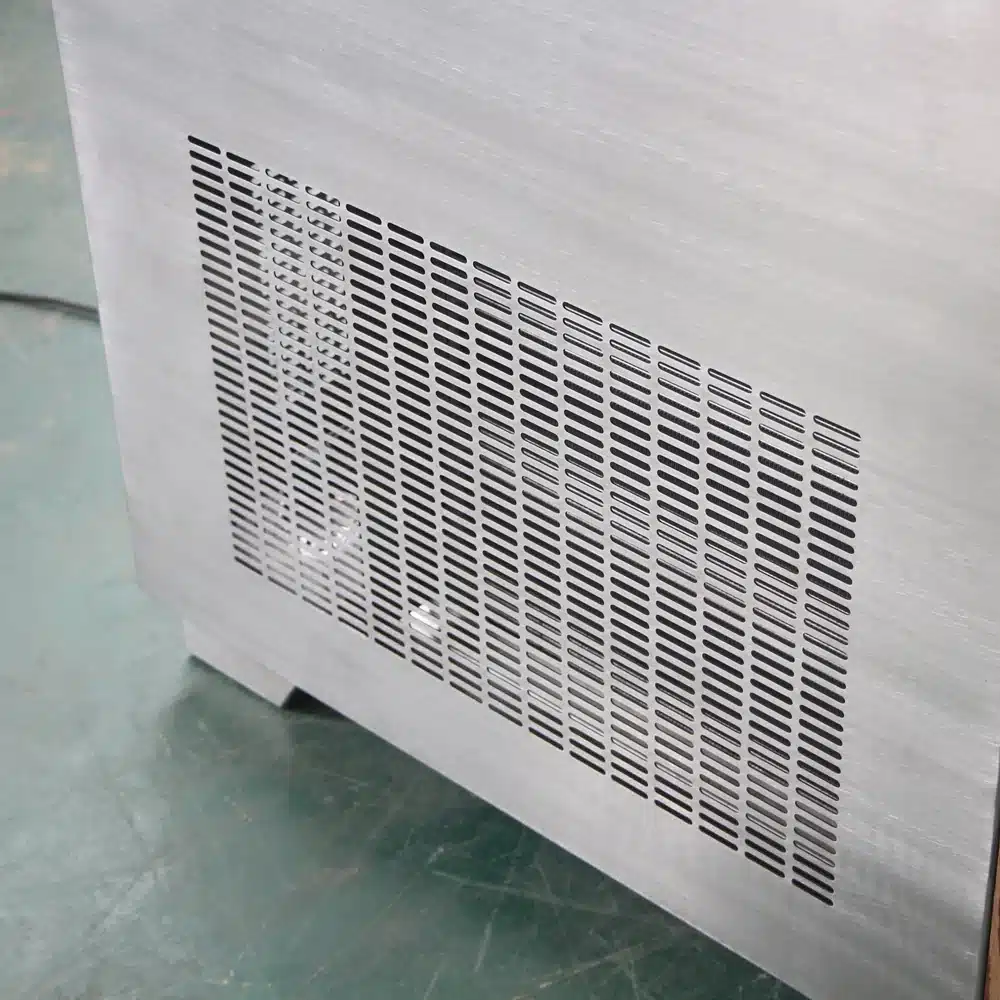
The CT-22 product record identifies an integrated ice-making system and asks buyers to confirm the exact configuration, connections and operating manual. Treat the visible panel as a prompt to request that information, not as a template for a homemade sound enclosure.
Do not wrap a cooling unit, cover its openings or add an enclosure simply to reduce an audible noise. Have the equipment supplier and responsible site professionals review any acoustic treatment together with ventilation, heat rejection, drainage and maintenance access. Use the installation-planning checklist to keep those requirements on the same drawing. This article specifies no universal clearance, mounting pad or enclosure design.
For a quiet room or a boundary-sensitive site, ask the project acoustic adviser to set the relevant receiver positions, operating periods, assessment method and acceptance criteria. A factory reading at one microphone position does not establish the result inside a neighboring room or demonstrate local compliance.
Agree the noise acceptance record before ordering
Attach the agreed test brief to the sample approval or purchase specification. Keep the following decisions explicit:
- Configuration: name the complete quoted assembly and document revision.
- Method: state the metric, test arrangement, operating modes, duration, reporting format and who performs the measurement.
- Acceptance: agree the threshold, treatment of uncertainty and process for a result that cannot be accepted. Do not borrow an unexplained number from a competitor listing.
- Site review: identify any separate installation assessment and the responsible local professional.
- Change control: ask whether a later component, controller or enclosure change requires the evidence to be reviewed again.
Keep a copy of the report, setup photographs and approved configuration with the model-specific manual and documents. If comparable evidence is unavailable, record “noise performance not yet verified” and decide whether to hold sample approval or arrange an agreed test. Missing data is not a zero-noise result.
If an installed unit develops a new sound, use the Bropool after-sales request process with the model, order reference, operating state and a safe recording. This purchasing guide does not diagnose the fault or authorize dismantling, bypassing protection or changing pump and cooling controls.
For a new Bropool project, send the destination, intended use, proposed location, complete system preference and the noise evidence your team needs. State whether the concern is the user’s experience, an adjoining room or a site requirement, so the open questions can be reviewed against a specific configuration.
Request a model-specific cold plunge review
Prepared by Bropool. Product records and external terminology sources reviewed on 11 October 2026. The checklists are editorial procurement guidance, not a standardized acoustic test, certification or guarantee of site performance.